
A tree that costs $300 to remove in most of the country can easily run $1,500 or more in New York City, and the difference isn’t padding, it’s the realities of working in a dense urban environment. These costs are all part of the overall quote provided and are often not apparent to homeowners: tight lots, overhead power lines, permit requirements for street trees, exorbitant labor rates. From a dead tree that’s threatening to ruin your roof to just making room in a back yard in Queens, you can know the difference between a good bid and a bad one with a bit of understanding of how NYC’s pricing is determined. The full 2026 details, borough by borough and factor by factor.
Quick Answer: Average Tree Cutting Costs in NYC
Most homeowners across the five boroughs pay between $500 and $1,200 for a standard residential tree removal, though the full range runs much wider depending on size and access.
| Tree Size | Typical Height | Estimated Cost Range |
| Small | Under 25 ft | $225 – $450 |
| Medium | 25 – 50 ft | $450 – $1,000 |
| Large | 50 – 80 ft | $1,000 – $2,000 |
| Very Large / Complex Access | 80 ft+ | $2,000 – $3,500+ |
Citywide, tree removal averages land around $845, but the low end can start near $225 for a small, easily accessible tree, while a large hardwood with restricted access can climb past $2,500.
How Pricing Actually Breaks Down
NYC tree services can be charged in three ways and a quote will reflect each of the charges:
- Single tree pricing structure for residential jobs, most common form of pricing is flat per tree, accounting for height, trunk diameter, species and “tree difficulty”.
- A rate per hour (more often for larger or multi-tree work). The cost of a single climber is $90 to $175 per hour, and a full crew with a certified arborist may charge $150 to $300 per hour or higher.
- Arborist assessment fees, which are typically $100-$250 and are an additional charge, to have an ISA certified arborist assess the health or structural risk of the tree before the tree is cut. This is worthwhile on any tree close to a building, fence line or power line.
Always request an itemized breakdown, which includes separate prices for felling, hauling, chipping and stump work. You can’t know exactly what you have bought when a single bundled number is included in your bill and you can’t fairly compare bids.
What Drives NYC Tree Cutting Costs Higher Than Almost Anywhere Else
Trunk diameter and size of trees. As the trees get larger, the time spent on the saw increases, the rigging to handle heavy logs becomes heavier, and the amount of debris to be hauled increases, with costs quickly rising if you’re working above 50 feet.
Accessibility. This is the largest distinction between pricing in NYC and the rest of the country. Many of Brooklyn’s, Queens’ and parts of the Bronx’ backyards are surrounded by walls, garages and other buildings, and often have no truck access whatsoever. If such a job requires a crane, rooftop rigging or manual piece-by-piece dismantling due to inability of equipment to get to the site, add $500 to $2,000 to the base price.
Borough and neighborhood. Because of the stricter regulations, limited availability for street parking of equipment and potential traffic control requirements if a crew will be closing a lane or blocking a sidewalk, Manhattan jobs often command a higher rate. Fenced, compact backyards in Brooklyn and Queens often need to be dismantled by hand, as opposed to simply being dropped, which can also affect the price.
Tree species. Many of NYC’s street and private trees, such as London planetree, honeylocust, and Callery pear, are well known for their heavy leaf drop and dense limb structure, which requires increased cutting and cleanup. Oaks and maples are also common throughout the city and are dense hardwoods which will require more time to be cut and removed safely than a softer wood.
Tree health and condition. Believe it or not, a healthy, structurally sound tree may cost more to remove than a dead or downed tree because live wood is heavier and is more carefully rigged. A tree that is already down as a result of a storm may only cost $100-$500 to remove, or a large healthy tree in the same location may cost $800-$1600.
Nearness of power lines and structures. When trees are in close proximity to an over-head power line, a roof, or nearby buildings, slower and more careful tree cutting technique and sometimes working in cooperation with the power company is required, which can increase the job cost by $200 to $1,000.
Number of trees. If multiple trees are removed during a single visit, the average removal cost per tree is typically reduced, as the mobilization of equipment and crew preparation is spread out over the entire job and is not billed separately for each tree.
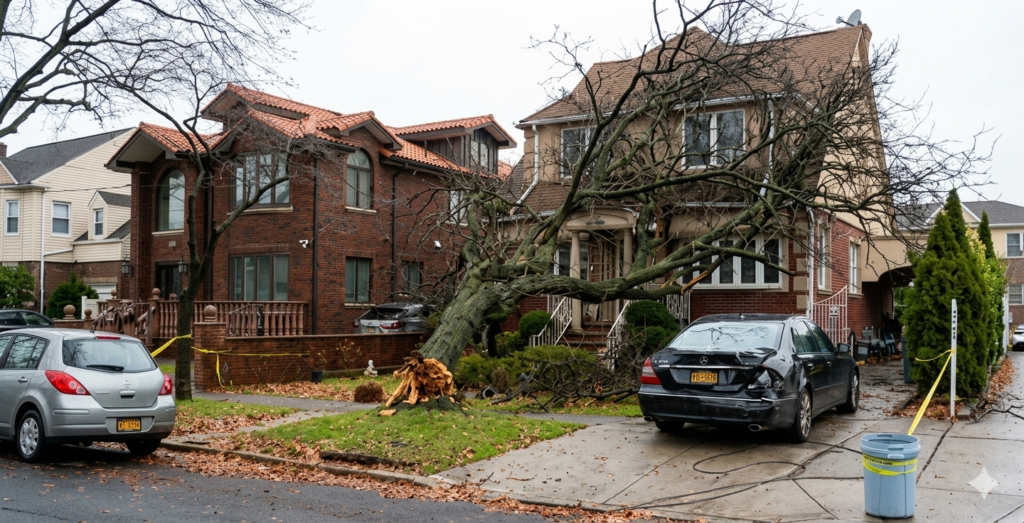
Timing. Emergency/storm-response removals come at a premium because the trees need to be removed at a moments notice, such as a tree falling on a driveway, leaning against a building or blocking access. Routine, planned removals booked in the dormant season (late fall through early spring) are often less expensive than those booked during the “busy season” in the spring and summer.
Debris, Stump Removal, and Other Add-Ons
Once a tree is down, several common add-ons affect your final bill:
- Hauling the tree away: roughly $70 per load
- Chipping into mulch: roughly $95
- Splitting into firewood: roughly $70, if you’d rather keep the wood
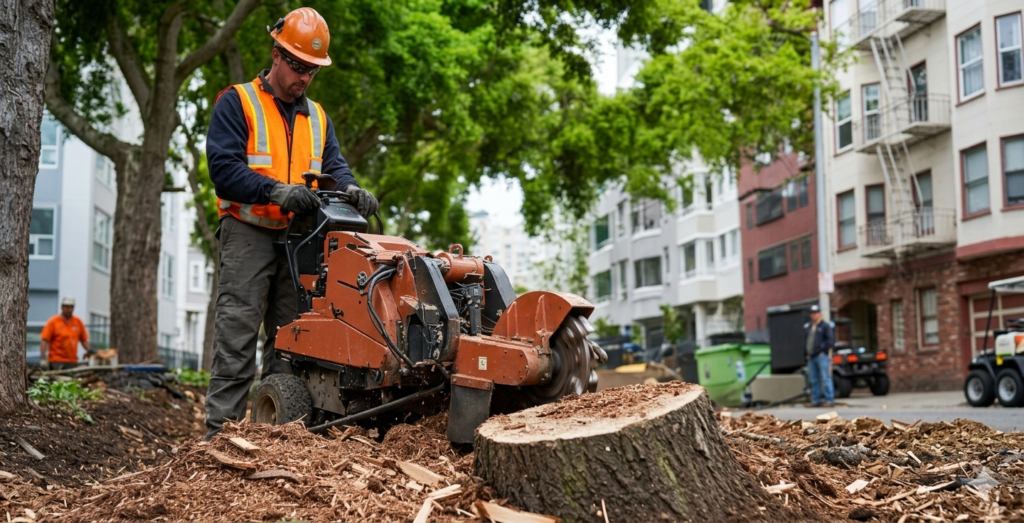
- Stump grinding: $60 – $350 per stump, generally priced at $2 to $3 per inch of diameter
- Full stump removal (extraction): $750 – $1,010, since it involves pulling the root ball rather than just grinding below grade
- Dumpster or wood chipper parking permit: $30 to $150 through NYC’s Department of Transportation, if equipment needs to sit on the street or sidewalk most reputable companies handle this permit on your behalf
Always confirm which of these are included in your quote versus billed as extras. A low initial number that excludes hauling and stump work can end up costing more than a slightly higher, all-inclusive bid.
Permits: The Cost Factor Most Homeowners Miss
The great news for private property owners is that NYC in general does not require a permit for the removal of a tree that is completely on your own property (residential lot). Street trees, those trees partially within the boundaries of the sidewalk, are under the care of NYC Parks and only can be pruned or removed with a Tree Work Permit from the city.
However, there are a few cases in which the city does get involved in the cost. If the tree is located on a landmarked property or in a historic district, it might require review by the Landmarks Preservation Commission prior to removal. When a tree removal necessitates the closure of a sidewalk or street, the crew will need an additional DOT permit to work on the street. Plus, if a dumpster or chipper truck has to be placed on the street while the work is being done, that $30-$150 DOT permit will be in effect too but it should be your contractor’s, not yours.
Failure to get the necessary permit on a street tree is a serious violation, however, under NYC Administrative Code § 18-129, with fines up to $15,000 per tree. Before any tree removal is done, a well-known tree service in NYC will be able to tell you right away if the tree is under the jurisdiction of the city.
Choosing a Tree Cutting Company in NYC
The state of New York does not mandate special licensure for tree removal contractors it is up to you to check them out. At minimum, confirm the company carries liability and workers’ compensation insurance, since a mishandled removal near a building or property line can get expensive fast. Inquire about having an ISA Certified arborist on staff, especially if in the vicinity of a building or large trees. And receive a written estimate which outlines the work involved in removal, hauling, chipping, and stump work and what you are paying for prior to the arrival of the crew.
Tree Cutting NYC offers complimentary and no pressure quotes throughout all 5 boroughs, and their certified arborists are familiar with the problems of access to NYC homes and the city’s permit regulations. When you have a tree which needs to be removed, contact us for an upfront quote.